From the Philippines to the World Stage: Dr. Daryl Joel Dumdum Joins International Faculty at the 11th IASRM World Congress in New Delhi
From the Philippines to the World Stage: Dr. Daryl Joel Dumdum Joins International Faculty at the 11th IASRM World Congress in New Delhi
Filipino Physician and Regenerative Medicine Researcher to Present on the Scientific Convergence of MSCs, NK Cells, and Extracellular Vesicles
NEW DELHI, INDIA — September 25–27, 2026
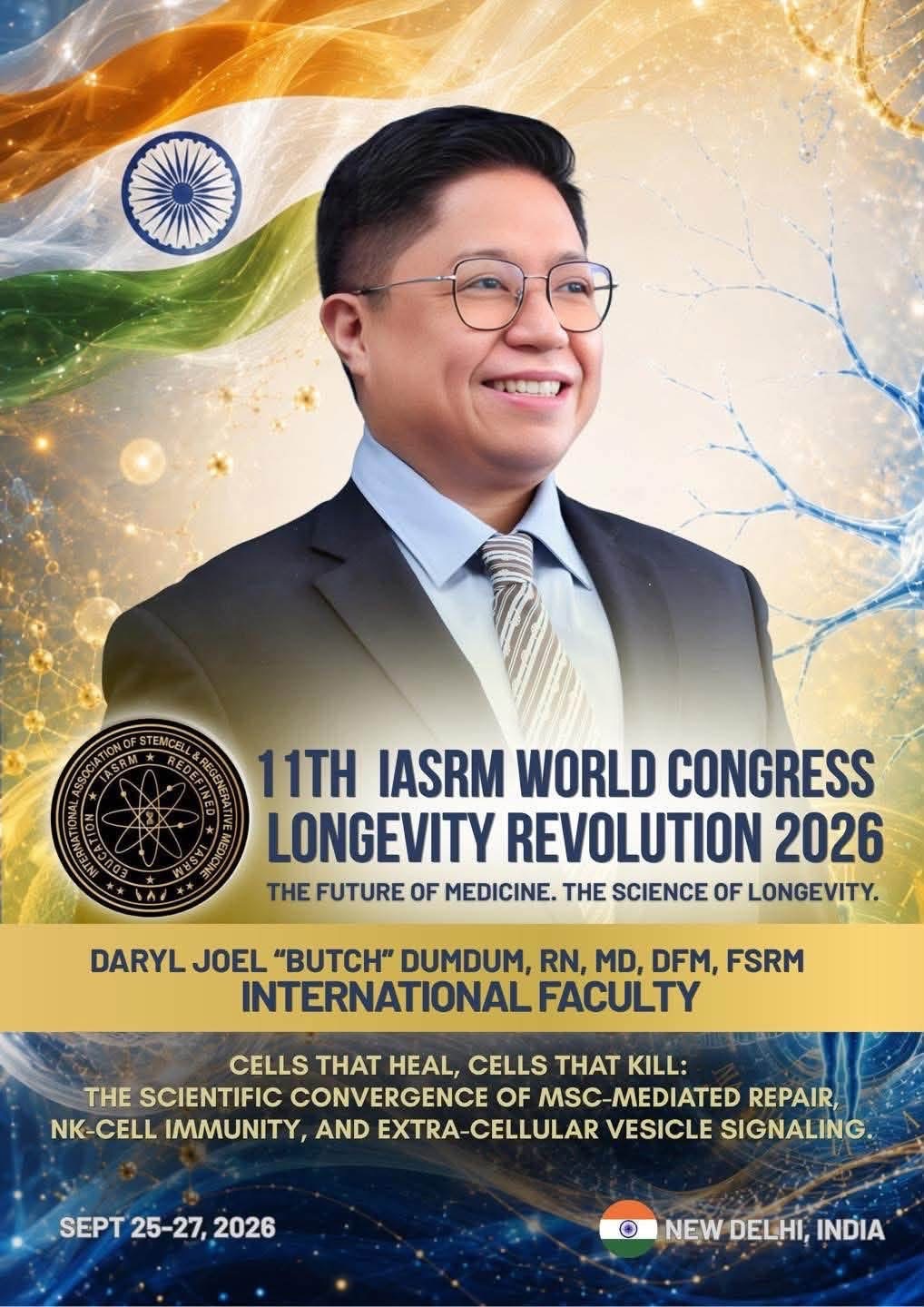
Another milestone for Philippine regenerative medicine is set to take place this September as Dr. Daryl Joel Dumdum, MD, DFM, FSRM joins an international group of physicians and experts at the 11th IASRM World Congress – Longevity Revolution 2026 in New Delhi, India.
Dr. Dumdum has been invited as International Faculty under Regenerative Medicine and Cellular Science, representing the Philippines alongside faculty members from different countries and specialties.
For Dr. Dumdum, the invitation represents more than another international speaking engagement.
It is an opportunity to bring the growing Philippine experience in regenerative medicine, cellular therapy, and clinical research to an international scientific audience.
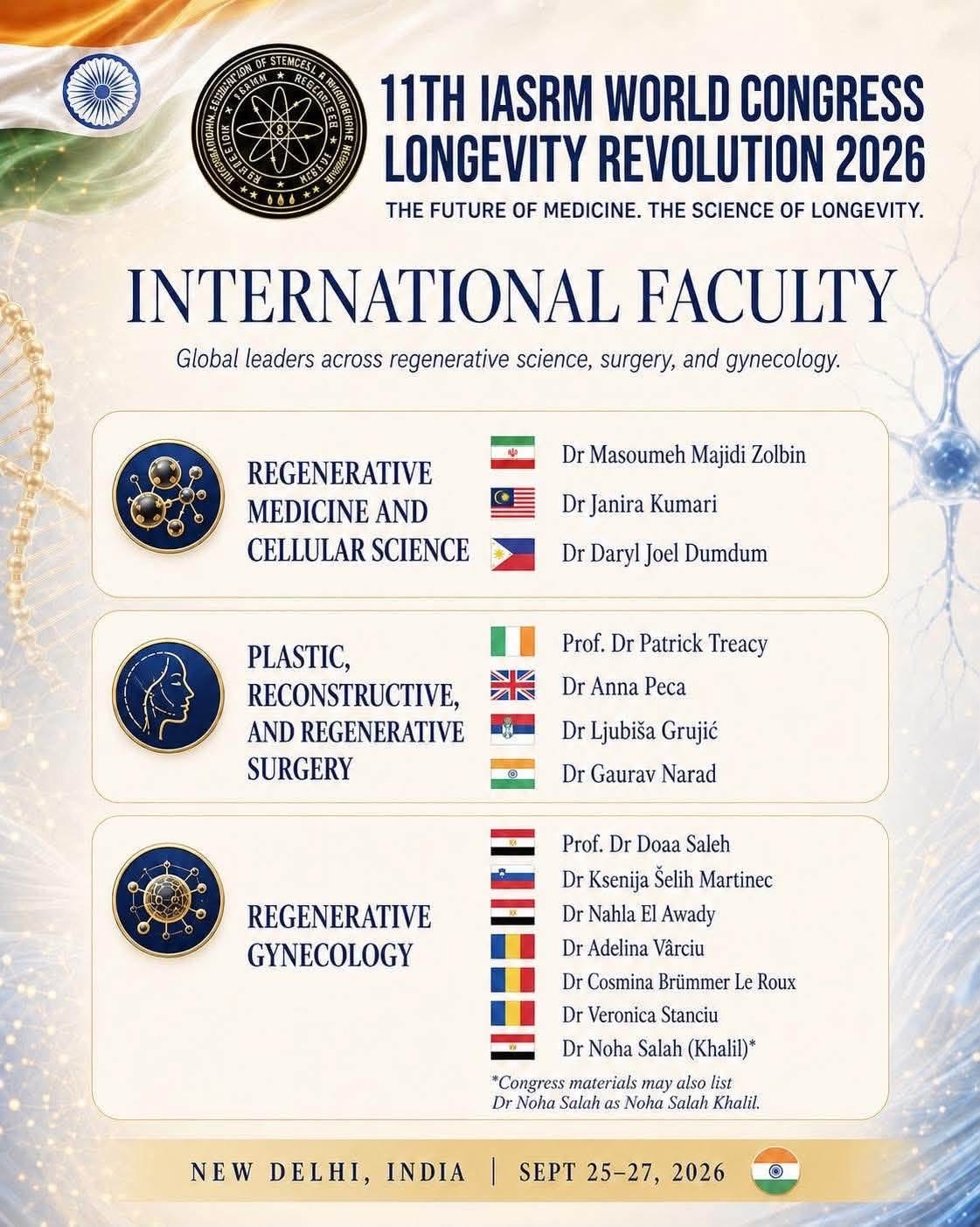
Representing the Philippines in Regenerative Medicine and Cellular Science
The 11th IASRM World Congress brings together international faculty working across regenerative medicine, cellular science, regenerative surgery, gynecology, longevity, and related emerging fields.
Among the international faculty in Regenerative Medicine and Cellular Science, Dr. Dumdum will represent the Philippines alongside physicians representing Iran and Malaysia.
His participation reflects a broader personal mission: for Filipino physicians to become not merely consumers of emerging medical technologies, but active contributors to the international conversation surrounding regenerative medicine.
“The Philippines has the clinical talent and scientific potential to contribute meaningfully to regenerative medicine. We should not only follow where the science is going — we should participate in creating the evidence that determines where it goes next.”
Cells That Heal, Cells That Kill
At the congress, Dr. Dumdum will deliver a scientific presentation entitled:
“Cells That Heal, Cells That Kill: The Scientific Convergence of MSC-Mediated Repair, NK-Cell Immunity, and Extracellular Vesicle Signaling”
The lecture explores three rapidly developing areas of cellular medicine:
Mesenchymal stromal/stem cells (MSCs) and their potential roles in immunomodulation, paracrine signaling, and tissue-repair biology;
Natural Killer (NK) cells, an important component of innate immunity capable of recognizing and eliminating abnormal cells;
and extracellular vesicles (EVs), microscopic biological messengers through which cells can transfer proteins, lipids, RNA, and other signaling molecules.
At first glance, these may appear to represent separate areas of medicine.
One focuses on repair.
Another focuses on immune defense.
Another focuses on communication.
But emerging science increasingly demonstrates that regeneration and immunity are interconnected biological systems.
That intersection forms the central scientific question of Dr. Dumdum’s presentation.
Cells That Heal: Understanding MSC-Mediated Repair
MSCs have become among the most extensively investigated cell populations in regenerative medicine.
However, the scientific understanding of how MSCs may exert biological effects has evolved considerably.
The earlier narrative of stem cells simply traveling to damaged organs and transforming into replacement tissue has given way to a more complex understanding involving paracrine signaling, immune modulation, growth factors, and extracellular-vesicle communication.
MSCs may influence the biological environment surrounding injured tissues rather than functioning merely as replacement cells.
Understanding these mechanisms is critical to developing more rational and evidence-based regenerative therapies.
Cells That Kill: The Power of Natural Killer Cells
On the opposite side of the biological equation are Natural Killer cells.
NK cells are specialized immune cells that form part of the body’s innate defense system. They are capable of identifying and destroying certain abnormal, infected, and malignant cells without requiring the same type of prior sensitization associated with some adaptive immune responses.
This ability has made NK cells an increasingly important area of cancer immunotherapy research.
Scientists are now investigating expanded NK cells, donor-derived approaches, engineered NK cells, and CAR-NK technologies across different malignancies.
For regenerative medicine physicians, this raises an important concept:
True cellular medicine is not only about stimulating regeneration. It is also about understanding immune surveillance and biological balance.
The Language Between Cells: Extracellular Vesicles
Connecting these biological worlds are extracellular vesicles.
Cells throughout the body constantly communicate.
They release microscopic membrane-bound particles containing proteins, lipids, nucleic acids, and signaling molecules capable of influencing neighboring and distant cells.
Extracellular vesicles have consequently become one of the fastest-growing areas of cellular research.
They are being investigated in regenerative biology, immune signaling, cancer, diagnostics, and drug-delivery systems.
Understanding these cellular messages could eventually allow medicine to influence biological processes with far greater precision.
Where Regeneration and Immunity Meet
This convergence represents one of the most exciting frontiers in modern medicine.
Traditionally, medical specialties often study biological systems separately.
Regenerative medicine asks how tissues can repair.
Immunology asks how the body defends itself.
Oncology asks how malignant cells survive and how they can be destroyed.
Cell biology asks how cells communicate.
But the human body does not operate in isolated specialties.
These systems interact continuously.
The future of cellular medicine may therefore depend upon understanding the balance between:
repair and surveillance,
inflammation and resolution,
cell survival and cell destruction,
regeneration and immune control.
This is the scientific landscape behind “Cells That Heal, Cells That Kill.”
Research as the Foundation
Dr. Dumdum’s international presentation is also closely connected with his growing research portfolio.
His research interests include the safety of allogeneic human mesenchymal stromal/stem cells, extracellular-vesicle and exosome therapy, neurological regenerative medicine, and cell-based therapies.
His work includes systematic reviews, meta-analyses, and clinical case research examining regenerative medicine from both the scientific and clinical perspectives.
This research-driven approach reflects an important principle behind his work:
Regenerative medicine must evolve from experience to evidence.
Clinical observations can generate questions.
Those questions should lead to systematic investigation.
And eventually, those investigations should contribute to the scientific literature.
From Davao City to New Delhi
Dr. Dumdum’s participation is particularly meaningful because much of his work has been developed from Davao City in Mindanao.
Through SH360 Medical Corporation and Sure Health 360 Center for Regenerative Medicine and Cell Therapy, he has worked toward developing a regenerative medicine ecosystem integrating clinical practice, research, physician education, international collaboration, and healthcare innovation.
What began in Davao has progressively developed connections across the Philippines and internationally.
The New Delhi congress represents another step in that journey.
Building International Bridges for Philippine Medicine
International conferences provide more than opportunities to lecture.
They create opportunities for physicians and researchers from different healthcare systems to exchange ideas, challenge assumptions, establish research relationships, and potentially develop future collaborations.
Dr. Dumdum has consistently pursued international exposure as part of his approach to healthcare leadership — learning from institutions and experts abroad while bringing those experiences back to Philippine practice, research, and medical education.
The ultimate objective is not simply international visibility.
It is international connectivity.
For Philippine regenerative medicine to progress, Filipino physicians and researchers must participate in the same scientific conversations taking place throughout the world.
A Filipino Physician on the International Stage
Being named to the international faculty of the 11th IASRM World Congress is therefore both an achievement and a responsibility.
Dr. Dumdum will carry the Philippine flag alongside international physicians and scientists working at the frontiers of regenerative medicine.
His message is centered not on extraordinary promises, but on scientific convergence:
How do MSCs influence repair?
How do NK cells protect the body?
How do extracellular vesicles allow cells to communicate?
And what happens when we begin studying these systems together rather than separately?
These questions may ultimately help define the next generation of regenerative and cellular medicine.
The Future of Medicine Is Converging
The boundaries between specialties are becoming increasingly blurred.
Regenerative medicine is intersecting with immunology.
Immunology is transforming oncology.
Cell biology is converging with precision medicine.
Extracellular vesicles are opening new approaches to cellular communication.
And biotechnology is giving physicians tools that previous generations could only imagine.
For Dr. Daryl Joel Dumdum, MD, DFM, FSRM, participating in the 11th IASRM World Congress represents another opportunity to contribute to that evolving conversation — while proudly representing Davao, Mindanao, and the Philippines on the international stage.
Because the future of medicine may not belong to a single cell, treatment, or specialty.
It may belong to understanding how they all work together.
About Dr. Daryl Joel Dumdum
Dr. Daryl Joel Dumdum, MD, DFM, FSRM is a Diplomate in Family Medicine and Fellow in Stem Cell and Regenerative Medicine. He is a physician, researcher, educator, healthcare entrepreneur, and CEO of SH360 Medical Corporation.
His professional and research interests include mesenchymal stromal/stem cells, extracellular vesicles, NK-cell biology, regenerative medicine, cellular therapy, cancer interception, precision healthcare, and healthcare innovation.
Event
11th IASRM World Congress – Longevity Revolution 2026
September 25–27, 2026
New Delhi, India
Scientific Presentation:
Cells That Heal, Cells That Kill: The Scientific Convergence of MSC-Mediated Repair, NK-Cell Immunity, and Extracellular Vesicle Signaling


Comments
Post a Comment