Cells That Heal, Cells That Kill: Dr. Daryl Joel Dumdum Brings His Expanded Scientific Lecture to the PSRM 1st Annual Convention 2026
Cells That Heal, Cells That Kill: Dr. Daryl Joel Dumdum Brings His Expanded Scientific Lecture to the PSRM 1st Annual Convention 2026
From MSC-Mediated Repair to NK-Cell Immunity and Extracellular Vesicle Signaling—Exploring What Happens When Regeneration and Immune Surveillance Converge
By Dr. Daryl Joel Dumdum, MD, DFM, FSRM
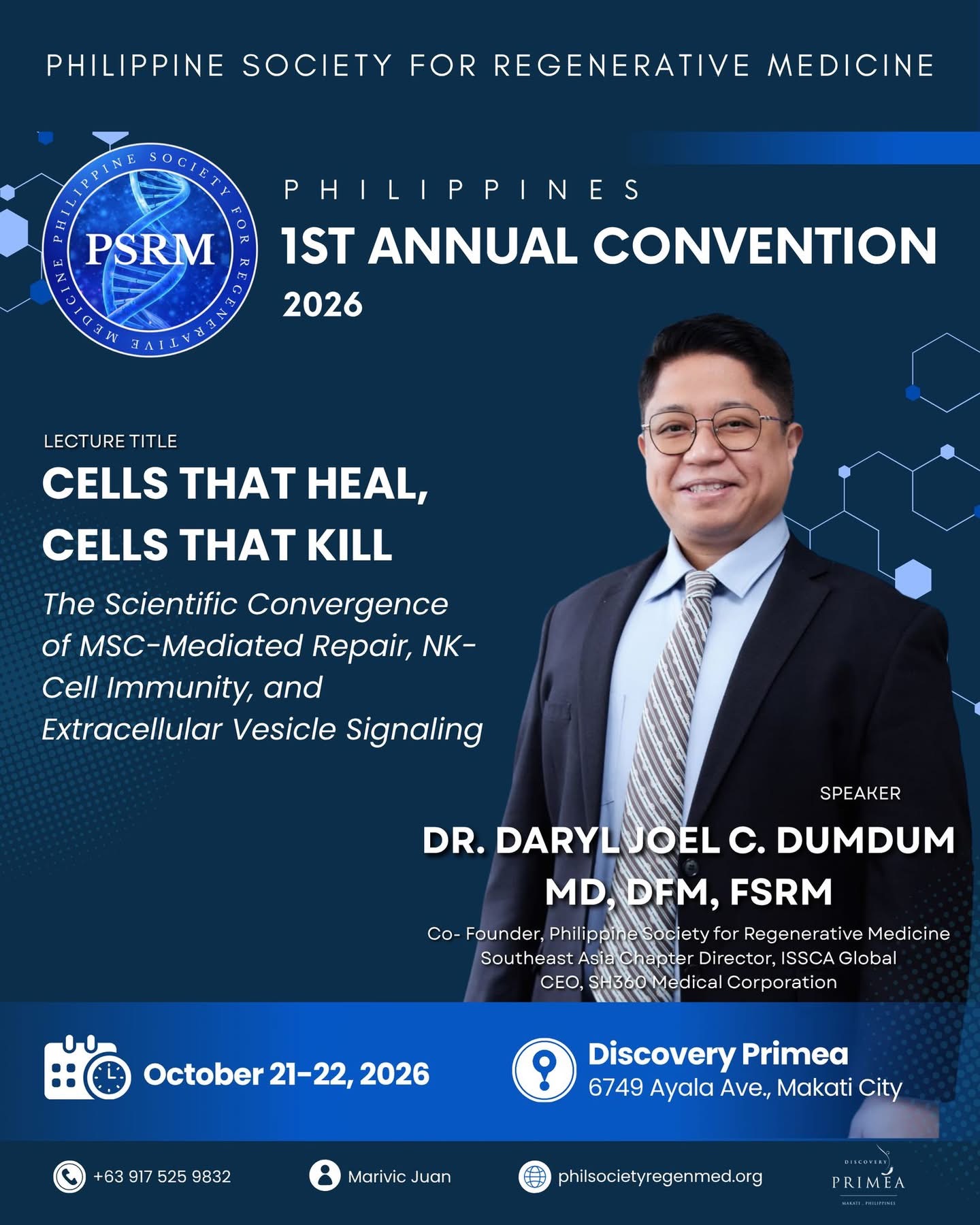
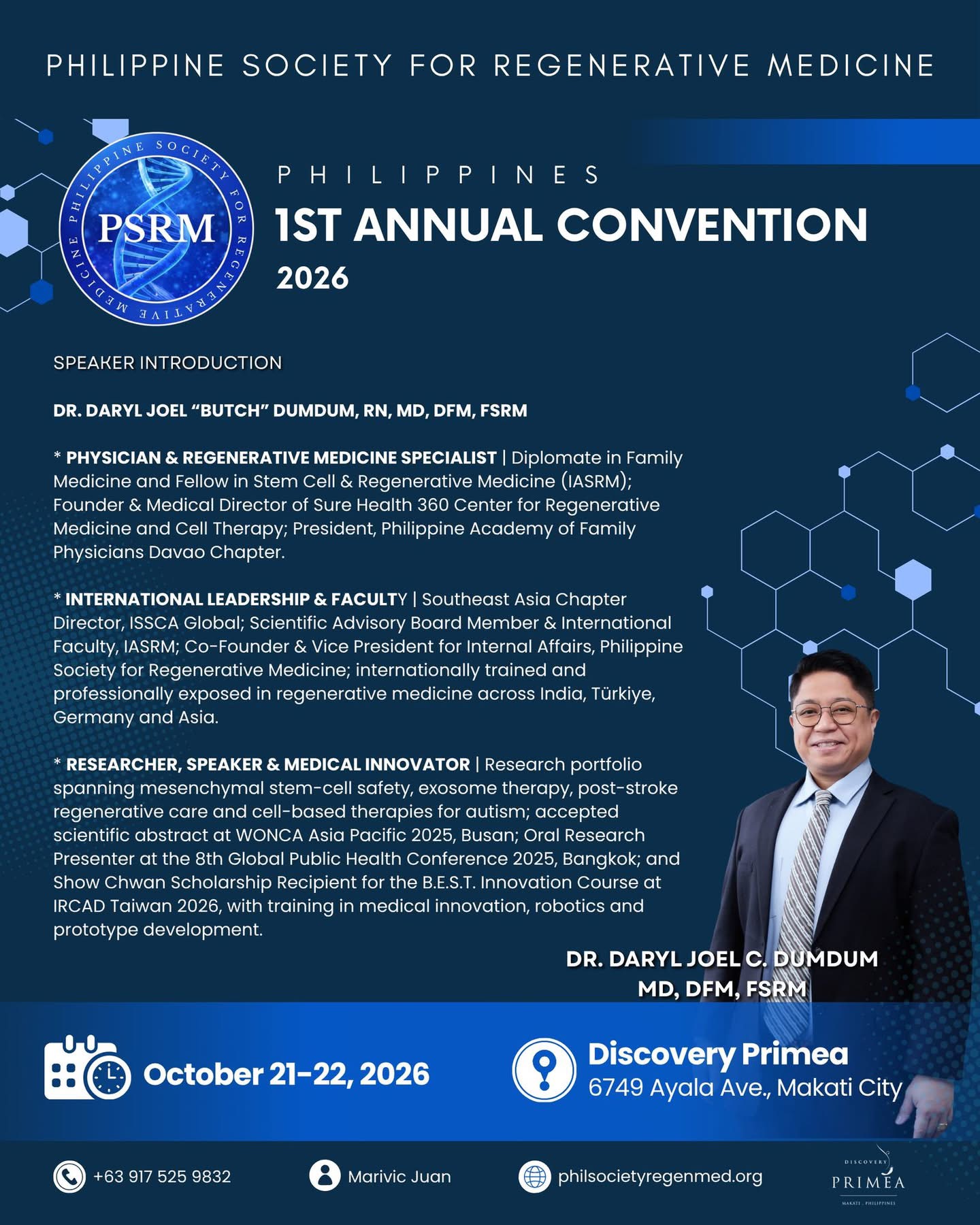
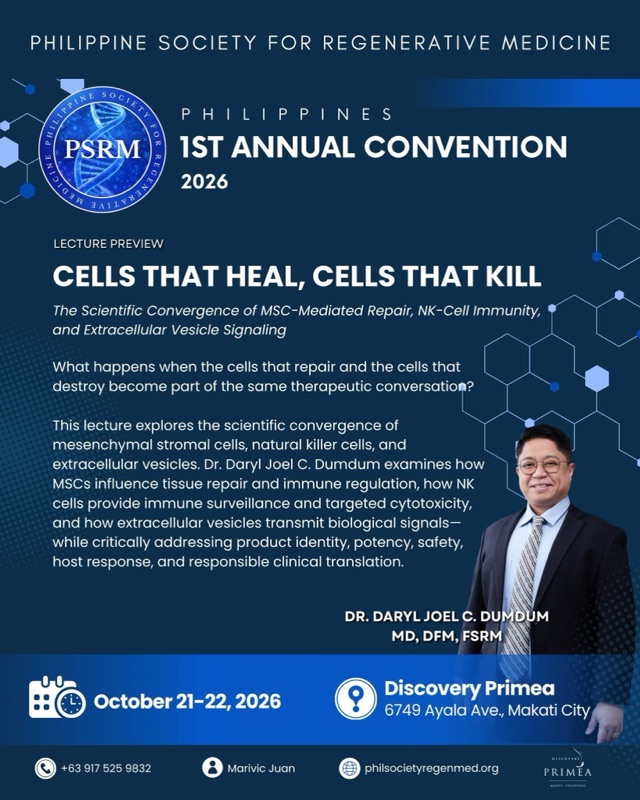
What happens when the cells that help regulate repair and the cells designed to destroy abnormal cells become part of the same therapeutic conversation?
This is the central question behind my upcoming scientific lecture:
“Cells That Heal, Cells That Kill: The Scientific Convergence of MSC-Mediated Repair, NK-Cell Immunity, and Extracellular Vesicle Signaling.”
Following the condensed version that I will present at the 11th IASRM World Congress – Longevity Revolution 2026 in New Delhi, India, I will deliver the expanded version of this lecture in the Philippines during the 1st Annual Convention of the Philippine Society for Regenerative Medicine (PSRM) on October 21–22, 2026 at Discovery Primea in Makati City.
The longer format allows us to go much deeper.
Rather than simply discussing three emerging therapeutic platforms—mesenchymal stromal cells (MSCs), Natural Killer (NK) cells, and extracellular vesicles (EVs)—I want to examine the biological relationships between them.
Because the future of regenerative medicine may not be about choosing one cell over another.
It may be about understanding the cellular ecosystem.
The Central Question: Can We Regenerate Without Understanding Immunity?
For years, regenerative medicine has largely focused on a compelling biological objective:
How can we help injured tissues repair?
Meanwhile, cancer immunology has been asking almost the opposite question:
How can we identify and destroy abnormal cells?
These appear to represent two different worlds.
One seeks repair and regeneration.
The other seeks recognition and destruction.
But biologically, these processes are deeply interconnected.
Tissue repair requires carefully controlled inflammation. Immune cells influence healing. Damaged tissues release signals that alter immune behavior. Tumors manipulate many of the same signaling pathways. And extracellular vesicles continuously carry molecular information between cells.
This leads to a much more sophisticated question:
How do we promote regeneration without ignoring immune surveillance—and how do we manipulate immunity without disrupting physiological repair?
That is where this lecture begins.
Part I — Cells That Heal: What Are MSCs Really Doing?
Mesenchymal stromal cells are among the most widely investigated cellular platforms in regenerative medicine.
But our scientific understanding of MSCs has changed substantially.
The early narrative was simple:
Administer stem cells → cells reach damaged tissue → cells become replacement tissue.
The modern picture is considerably more complex.
Much of the interest in MSCs now centers on their paracrine and immunomodulatory activity—the ability to influence surrounding cells through soluble mediators and extracellular signals.
MSCs can interact with multiple components of the immune system, including macrophages, dendritic cells, T cells, B cells, and importantly for this lecture, Natural Killer cells. Their behavior can also vary according to the inflammatory microenvironment and manufacturing or culture conditions.
So perhaps we should stop thinking of MSCs merely as cellular building blocks.
A more interesting way of thinking about them is as:
Biological signaling factories.
That changes the entire regenerative medicine conversation.
Part II — The MSC Secretome: Is the Message as Important as the Cell?
If MSCs exert important effects through what they secrete, then we naturally arrive at the next question:
What exactly are these cells sending to other cells?
This brings us into the rapidly expanding science of the secretome and extracellular vesicles.
Extracellular vesicles are membrane-bound particles released by cells that can carry proteins, lipids, nucleic acids, and other biologically active molecules.
MSC-derived extracellular vesicles are being investigated for their potential immunomodulatory and tissue-repair effects. Recent reviews describe their ability to influence both innate and adaptive immune responses, although major translational challenges remain around isolation, characterization, standardization, potency, and manufacturing.
This raises one of the most provocative questions I will explore during the lecture:
If part of the therapeutic activity of MSCs comes from the messages they release, could we eventually harness the message without administering the entire cell?
That is one of the scientific foundations behind growing interest in cell-free regenerative strategies.
But it also creates new problems.
How do we define an EV product?
How do we establish potency?
How do we standardize dose?
And how do we know that two products both labeled “exosomes” are biologically comparable?
These questions matter enormously when moving from laboratory science to clinical medicine.
Part III — Cells That Kill: Meet the Natural Killer Cell
Then we move from regeneration to defense.
Natural Killer cells are part of the innate immune system.
Unlike conventional concepts of targeted adaptive immunity, NK cells possess the remarkable ability to recognize cellular stress and abnormalities and can eliminate certain infected or malignant cells.
Their cytotoxic machinery includes mechanisms involving molecules such as:
Perforin
Granzymes
and death-receptor pathways.
This makes NK cells an increasingly important platform in modern cancer immunotherapy research.
But NK-cell therapy also faces significant challenges—particularly in solid tumors, where persistence, trafficking into tumors, and the immunosuppressive tumor microenvironment can limit activity.
And this is where the lecture becomes more interesting.
Because MSCs and NK cells do not operate independently.
They communicate.
Part IV — When Cells That Heal Meet Cells That Kill
This is one of the scientific centerpieces of the lecture.
What happens when MSCs encounter NK cells?
The relationship is not simply cooperative.
And it is not simply antagonistic.
It is bidirectional.
Experimental research has demonstrated that MSCs can alter NK-cell proliferation, cytokine secretion, phenotype, and cytotoxic activity through both cell-to-cell contact and soluble mediators.
At the same time, sufficiently activated NK cells can recognize and lyse MSCs under certain experimental conditions.
Think about the implications.
The cell we associate with repair can influence the cell we associate with killing.
And the cell designed to kill abnormal targets may itself influence or eliminate the cell being investigated for regeneration.
This is why the lecture is called:
Cells That Heal, Cells That Kill.
The relationship between regeneration and immunity is not a straight line.
It is a biological conversation.
Part V — Extracellular Vesicles: The Language Between the Cells
Now we introduce the third player.
Extracellular vesicles may serve as one of the communication systems connecting these cellular worlds.
MSCs release EVs.
NK cells release EVs.
Tumor cells release EVs.
And these vesicles can influence the behavior of other cells.
That means extracellular vesicles cannot automatically be described as “good” simply because they are associated with regenerative medicine.
Their biological effect depends heavily on their cell of origin, molecular cargo, recipient cell, and surrounding microenvironment.
This becomes especially fascinating in cancer.
NK-cell-derived vesicles are being investigated because they may carry cytotoxic components associated with their parent NK cells.
But tumors can play the same game.
Recent research describes how cancer-derived extracellular vesicles may contribute to immune evasion, including interference with NK-cell recognition, survival, migration, metabolism, and cytotoxic function.
The extracellular vesicle is therefore not simply a treatment platform.
It is part of a biological communication network.
The Tumor Microenvironment: Where the Battle Changes
This leads us to another major topic:
The tumor microenvironment.
Cancer is not simply a collection of malignant cells growing uncontrollably.
A tumor exists within an ecosystem containing immune cells, stromal cells, blood vessels, signaling molecules, extracellular matrix, metabolites, and extracellular vesicles.
Within this environment, malignant cells can evolve mechanisms that suppress immune surveillance.
NK cells that are highly effective under laboratory conditions may behave differently when they enter this complex environment.
Understanding the tumor microenvironment therefore becomes essential when discussing future NK-cell therapies and cellular immunotherapy.
The important question is no longer simply:
Can an NK cell kill a cancer cell?
It becomes:
Can that NK cell reach the tumor, remain functional, resist suppression, recognize the target, and maintain sufficient cytotoxic activity within the patient’s biological environment?
That is a much more clinically meaningful question.
From Biology to the Bedside: Where Regenerative Medicine Must Become More Rigorous
The final part of my lecture will deliberately move away from excitement and toward clinical translation.
Because understanding mechanisms is only the beginning.
A biologically plausible therapy is not automatically a clinically effective therapy.
When translating cellular and extracellular-vesicle technologies into patients, we must address:
Product identity.
What exactly are we administering?
Purity and characterization.
Do we know what is actually inside the product?
Potency.
Can we demonstrate meaningful biological activity?
Dose.
What is the appropriate therapeutic exposure?
Route.
Where does the product go after administration?
Host response.
How does the patient’s immune system alter the intervention?
Safety.
What are the immediate and longer-term risks?
And ultimately:
Does the intervention produce clinically meaningful outcomes?
These are the questions that separate regenerative medicine as a scientific discipline from regenerative medicine as marketing.
What Will Physicians Learn From This Lecture?
This is not intended to be an introductory lecture explaining only what stem cells, exosomes, or NK cells are.
It is designed to take physicians one level deeper.
Participants will leave with a clearer understanding of:
- How MSC biology has evolved beyond the simple “cell replacement” model toward paracrine signaling and immunomodulation.
- How MSCs interact with immune cells, particularly NK cells, and why this relationship can be context-dependent.
- How NK cells recognize and eliminate abnormal cells and why they have become important candidates for cellular cancer immunotherapy.
- Why the tumor microenvironment can suppress NK-cell function and complicate translation from laboratory results to actual patients.
- How extracellular vesicles function as biological messengers between regenerative, immune, and malignant cells.
- Why MSC-derived, NK-derived, and tumor-derived EVs may have very different biological consequences.
- How the secretome and extracellular-vesicle field is changing the concept of “cell-free” regenerative medicine.
- Why product identity, characterization, potency, manufacturing, dose, route, and host response matter when evaluating regenerative products.
- Where current evidence ends and scientific uncertainty begins.
- And most importantly:
Why the future of regenerative medicine may depend on understanding regeneration, immunity, and cellular communication as one interconnected biological system.
The Full Version After India
At the 11th IASRM World Congress in New Delhi, the international audience will receive the concentrated version of this scientific argument.
At the PSRM 1st Annual Convention, we go deeper.
More mechanisms.
More evidence.
More translational questions.
More discussion of MSC–NK interaction.
More extracellular-vesicle biology.
More tumor microenvironment.
More attention to safety, potency, product identity, and responsible clinical translation.
This is the version designed particularly for physicians who want to understand not only what these emerging technologies are, but why they may work, why they may fail, and what we still need to prove.
Building a Scientific Culture for Regenerative Medicine in the Philippines
There is also a larger purpose behind this lecture.
The Philippines is entering an important period in regenerative medicine.
Patient interest is growing.
Cellular technologies are becoming increasingly accessible.
Physicians are becoming curious.
Research is expanding.
But increased access must be accompanied by increased scientific rigor.
As one of the co-founders of the Philippine Society for Regenerative Medicine, I believe our responsibility is not merely to promote regenerative medicine.
Our responsibility is to help professionalize it.
That means creating a community where physicians can critically examine evidence, understand cellular biology, discuss safety, question therapeutic claims, participate in research, and develop responsible standards of practice.
The first PSRM Annual Convention represents an important step toward building that community.
Three Technologies. One Biological Conversation.
MSCs teach us about repair.
NK cells teach us about surveillance and destruction.
Extracellular vesicles teach us that neither system operates alone.
The deeper we look into cellular biology, the more artificial the boundaries between regenerative medicine, immunology, oncology, and molecular medicine begin to appear.
Cells communicate.
Cells regulate one another.
Cells change according to their environment.
And sometimes, the same biological pathways that support healing can have very different consequences in another disease context.
Perhaps the next frontier of regenerative medicine is therefore not simply finding a more powerful cell.
Perhaps it is learning to understand the conversation between cells.
That is the journey behind:
CELLS THAT HEAL, CELLS THAT KILL
The Scientific Convergence of MSC-Mediated Repair, NK-Cell Immunity, and Extracellular Vesicle Signaling
Dr. Daryl Joel C. Dumdum, MD, DFM, FSRM
Philippine Society for Regenerative Medicine – 1st Annual Convention
October 21–22, 2026
Discovery Primea, Makati City, Philippines
About the Speaker
Dr. Daryl Joel C. Dumdum, MD, DFM, FSRM is a Diplomate in Family Medicine and Fellow in Stem Cell and Regenerative Medicine. He is Co-Founder of the Philippine Society for Regenerative Medicine, Southeast Asia Chapter Director of ISSCA Global, CEO of SH360 Medical Corporation, and President of the Philippine Academy of Family Physicians – Davao Chapter.
His research interests include mesenchymal stromal/stem-cell safety, extracellular-vesicle and exosome therapy, post-stroke regenerative care, cell-based therapies, and the emerging intersection between regenerative medicine and cellular immunotherapy.


Comments
Post a Comment